Author: ari

  • Theater + Music + Dance = Creative Partners’ THE UNEXPECTED


    Creative Partners
    , an innovative collaboration in the arts that brings together three leading Chicago companies (Blair Thomas & Company, eighth blackbird, and Lucky Plush Productions) invite audiences to THE UNEXPECTED — a launch event featuring performances and a reception on Thursday, April 25th, 2013, at 7pm at The Museum of Contemporary Art Chicago, 220 E. Chicago Ave. Tickets ($40) are available at www.cptheunexpected.eventbrite.com. On-site parking will be available for $11 in the MCA garage.

    Each company will present work from their award-winning repertory, including Blair Thomas & Co.’s “The Blackbird”, Lucky Plush’s “Cinderbox 2.0”, and eighth blackbird’s “These Broken Wings,” which was recently performed at the Grammys.

    Creative Partners pave the way for a new funding model and to make more art. As part of Creative Partners’ joint fundraising model, each company benefits from high-level fundraising assistance and cross-disciplinary audience development. The partner companies share an aesthetic of the new, the genre-bending, and the experimental; above all, each company believes that performances should tell you something and take you somewhere.


  • “Selfish Giant” at Milwaukee Art Museum

    selfishgiantOn Sunday, March 24, BT&Co will perform their adaption of Oscar Wilde’s The Selfish Giant at the Milwaukee Art Museum as part of of their Kohl’s Art Generation Family Sundays. The Selfish Giant will begin at 2:30 p.m. and is free with museum admission.

    A collaboration with singer-songwriter Michael Smith, The Selfish Giant adapts a revered fairy tale by Oscar Wilde into 45 minutes of music, magic, and impressive puppetry. “Thomas’s work is always best in an intimate setting,” says Chris Jones of the Chicago Tribune, and there are few venues more perfectly suited to Thomas’ work than the Milwaukee Art Museum (not in the least because the building itself is a puppet in its very design).


  • Moby-Dick Excerpts At Storefront Theater

    Moby-Dick Excerpts At Storefront Theater

    1W8A3200Blair Thomas & Company presents work-in-progress excerpts from its future production of Moby-Dick on Sunday, January 20th, 2013, at 2pm at Storefront Theater, 66 E. Randolph, Chicago. Admission is free – for reservations email [email protected]

    Narrator Ishmael recounts his journey on the Pequod as Captain Ahab’s relentless pursuit of the White Whale leads the entire crew to the depths of the ocean’s great unknown.  The words of this great American novel are brought to life on the stage through bunraku puppets and rolling paper scrolls.

    In the Works is a performance residency program that gives emerging and established performing artists the opportunity to test-drive new work in a public setting. Each residency is tailored to the needs of the artist or company and their project and each showing is a unique opportunity for audiences to get a behind-the-scenes look at new work by Chicago artists. This program is made possible through a grant from The Boeing Company. Admission is either free or low-cost.  Visit www.chicagocultuturalcenter.org for a complete schedule.


  • Mark Messing, composer

    Mark Messing,
    composer

    Mark Messing is a composer and musical agitator. He is Musical Director of circus punk marching band Mucca Pazza and has led the band from coast to coast through concert halls, public parks, neighborhood pubs and a dozen canoes on the Chicago River. They have travelled the country with their message of frenetic joy and through their benefit series they have brought funding and exposure to small local community organizations. He has composed music for numerous independent films including The First Breath of Tengan Rei (2009) by Junko Kajino and Ed M. Koziarski, and has been musical director for hundreds of theater performances. As Musical Director for Redmoon Theater he composed for 100 tiny radios at the Museum of Contemporary Art, a 35-foot drum tree at Millennium Park and musicians on stilts at Puppetropolis. His new company, Opera-Matic, performs Lullaby Parades on bicycle powered floats in Chicago neighborhoods at twilight. www.opera-matic.org; mucca-pazza.org. Shows with BT&Co: The Houdini Box, With Love From Edgar Allen Poe.

  • Moby-Dick coming to Logan Center, September 18

    Blair Thomas & Co, Lookingglass Theatre, and The House Theatre of Chicago are featured in EXPLORING MOBY-DICK – a night of three different adaptations of Herman Melville’s novel, in various sites of performance within the new Logan Center for the Arts in Hyde Park, Chicago. The event, which is free and open to the public, will take place on Wednesday, September 18 at 6:30pm at the Reva and David Logan Center for the Arts, 915 East 60th Street, Chicago. Audiences will move from space to space to experience the three adaptations, and are invited to join the artistic staff in the courtyard following the performance to discuss the work. Free advance tickets may be reserved at www.mobydickatlogan.eventbrite.com

    These three companies are all sharing mid-process works that explore this seminal American narrative from richly different artistic perspectives. According to Chelsea Keenan of the House Theatre: “What’s so exciting for the audience is to see that process, to get in on something rare and fleeting. What frames the three works at this stage will be not a traditional collaboration, but the source material and the astonishingly disparate directions the three groups will take them — we’ll likely witness surprising overlaps.”

    This event takes place as a part of the Summer Inc Residencies with Theater and Performance Studies at The University of Chicago. This project is supported by a grant from the Boeing Corporation.


  • Puppetry, performance and imagination at the Detroit Institute of Arts

    This past Sunday, I had the pleasure of taking in a performance of Blair Thomas & Company’s “A Kite’s Tale,” at the Detroit Institute of Arts (a Knight Arts grantee). It was a puppet show unlike any I had ever seen, involving a live performance by pianist Kathryn Goodson of Modest Mussorgsky’s “Pictures at an Exhibition,” and featured an engrossing combination of puppetry, costumes and theater. The performance was without dialogue, though the audience was given a brief and lively primer on the storyline at the start. The story itself was intensely surreal and imaginative, involving two “tricksters,” a dancing rabbit and a little girl with a bad temper and a red kite.

    Puppeteers (dressed in all black) control the actions of the little girl and a rabbit. Photo courtesy of Blair Thomas & Company

    Following in the tradition of Japanese bunraku theater, some of the puppets were life-sized, and others required several puppeteers to control. There was also a costume element to the show, including an enraged version of the story’s main character, a little girl who would lose control of her temper and transform from a three-foot tall puppet into a towering version of herself played by a costumed performer. The first time the transformation occurred, and the giant version of the little girl stepped suddenly onstage, the audience audibly gasped, and I saw many of the younger kids in the audience clinging tightly to their mothers. It was an electric moment, and just one of many throughout the show. The handcrafted and hand-painted puppets and dynamic performances transformed the event beyond the traditional concept of puppet show, and into an in-motion work of highly-refined folk art.

    The large versions of the little girl and the rabbit, seen here with the pianist. Image courtesy of Blair Thomas & Company

    I had the pleasure of catching up with Blair Thomas to ask him a few questions about the performance. The result of our conversation is below:

    Jeremy Schmall: Was there anything in particular that inspired “A Kite’s Tale?” Did the story emerge over time and through a process, or was it the sort of thing that sprung out fully formed?

    Blair Thomas: The story emerged over time as I worked on this show starting in 2005.  I listened to the music repeatedly and just imagined characters from the sound of movements.  It was clear there was some giant character, I imagined some mercurial trickster characters that would create some mischief, and I imagined a young child skipping through the woods — I was convinced there was some Sloth character too, but he never emerged.

    JS: What kind of time investment goes into a production like this, in terms of creating the story, doing the choreography and constructing the puppets?

    BT: It takes months to make the puppets — and the ones we are using now have been built a couple of times to get it right. Then rehearsal is a long process — I start with an imagined scenario of action that quickly is forced into revision as we stage moments to the music.  But the music dictates the narrative — I knew that at one point there would be a chase scene and another there would be a fight, another a moment of contemplative introspection, etc. For example, the movement where the little girl first becomes angry and turns into a giant was first a scene where the giant was playing with a butterfly but in the end crushes it. Then it was a stand off scene between the tricksters and the giant.

    The giant and the rabbit. Image courtesy of Blair Thomas & Company

    JS: Does your company fabricate all the costumes and puppets yourselves? What is that process like?

    BT: A group of designers built the puppets.  There were mold makers, someone else who figured out the mechanisms of their operations, a couple of different people designed and built the costumes, I painted most of them. This process has been ongoing with this show.

    JS: How did you originally get involved with doing puppet theater?

    BT: As a boy I lived in a small town without a movie theater or much else, and I got the idea of a puppet show. Without having seen one and with some store bought marionettes, I started making shows for birthday parties and church events.

    JS: I really enjoyed the use of different kinds of puppets throughout the performance, especially the bunrakupuppets, which I had never seen before. What is your history with bunraku?

    BT: Over the past years I have worked with different versions of the bunraku doll— I’ve done several human-size types. I like the direct response the puppeteer can give them.

    JS: I loved the dramatic moment when the giant version of the little girl steps on stage for the first time, which sent shockwaves through the audience. Were you worried at all about scaring some of the kids in that moment?

    BT: No not worried— surprise will often scare young kids — but surprise in the theater is one of its greatest assets. There are many kinds of surprise; this is an obvious one, but dynamic.

    JS: I noticed a lot of literary influence in your works, including Federico Garcia Lorca and an adaptation ofMoby Dick. Do you consider yours to be literary-focused company, or is literature just one of the many influences on your work?

    BT: I approached Mussorgsky’s score in the same way I have written word texts. A writer/composer can put a structural integrity into their writing that in itself is a form of storytelling. As a puppeteer, I am interested in the works that aren’t created for the stage because the puppet theater operates with a unique theatrical language itself, and the original source material is just one component of the performance. So I do take inspiration off of pre-existing works — I am interested in participating in the dialogue of tradition with our culture at large.

    Detroit Institute of Arts, 5200 Woodward Ave., Detroit; 313-833-7900, dia.org

  • Saint John’s University: Puppeteer Blair Thomas presents ‘The Hard Headed Heart’

    Saint John’s University: Puppeteer Blair Thomas presents ‘The Hard Headed Heart’

    Preview of Hard Headed Heart, from www.csbsju.edu

    High art meets low when the words of 20th century writers are given voice in puppeteer Blair Thomas’ production of “The Hard Headed Heart,” a cabaret that features wooden puppets, rolling paper scrolls and a one-man band.

    The CSB/SJU Fine Arts Series presents Thomas’ production at 8 p.m. Friday, Feb. 10, in the Stephen B. Humphrey Theater, Saint John’s University. Using a variety of traditional puppetry techniques, this solo performance presents a trio of interconnected solo shows:

    The Puppet Show of Don Cristobal: Based on the bawdy script by Federico Garcia Lorca, this play, performed with wooden hand puppets and a drum kit, is a humorous retelling of the traditional trickster Don Cristobal’s wooing and marriage to the delectable Dona Rosita.

    St. James Infirmary: Based on the traditional New Orleans folksong, this is a clever, romantic show whose main character is faced with the death of his lover. This piece is performed with rod marionettes, a motorized paper scroll and a one-man pit band.

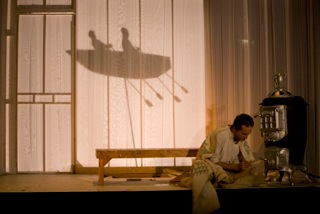
    The Blackbird: Based on the Wallace Stevens poem “13 Ways of Looking at a Blackbird,” this play is an inventive shadow puppet show that examines what happens when doubt inexplicitly finds its way in between the love of a man and a woman. This piece is performed on a set of four rolling scrolls, lit entirely by lamplight.

    As founder of the highly successful Redmoon Theater in Chicago, Thomas spent a decade leading a vision to create large-scale spectacle theater. He was the principal creator behind productions such as “Frankenstein,” the Winter Pageant, and All Hallow’s Eve Halloween parade until he left in 1998. Blair then served as co-curator for both of Chicago’s International Puppet Festivals in 2000 and 2001 and became an associate adjunct professor at the School of the Art Institute of Chicago.

    In 2002, Blair founded Blair Thomas & Co., which has built a repertoire of work for adults and for children. He was awarded the Illinois Arts Council Fellowship for New Performance in 2002 and 2004, and was hand-picked to serve in the inaugural position of Jim Henson Artist-in-Residence at the University of Maryland in College Park for the 2006-07 academic year.

    Tickets to “The Hard Headed Heart” are $30, Senior $27, and Student $10.  Contact the Box Office at 320-363-5777 or online atwww.csbsju.edu/fine-arts.  Please note: this performance contains adult themes.

    Related Event: Thomas, an ordained Buddhist monk, will lead a Buddhist meditation workshop from 9:30-11 a.m. Saturday, Feb. 11, at the Oratory of Saint Benedict’s Monastery in St. Joseph. This workshop will be an introduction to Buddhist meditation in collaboration with the Saint Benedict’s Monastery Spirituality Center. The workshop is free and open to all. Contact 320-363-7112 to register.

    via Puppeteer Blair Thomas presents ‘The Hard Headed Heart’ at SJU – CSB/SJU.

  • The Huffington Post: Behind the Scenes With Master Puppeteer, Blair Thomas

    Blair creates sophisticated puppet theatre for adults (and kids) and often does everything from puppet building, the costume creation, and music to the performances themselves. A bit of a one-man-band, through puppets Blair is able to tell deep and complex stories with the various characters often being different extensions of his own personality. Right! Not your average puppet show!

    via Elysabeth Alfano: Behind the Scenes With Master Puppeteer, Blair Thomas.

  • Puppetry tales have ‘Heart’ – Chicago Tribune

    Here he is literally a one-man band — the inventive small-scale sets (designed by Thomas) for two of the pieces, “The Puppet Show of Don Cristobal” and “St. James Infirmary,” include drum kits and other musical instruments that Thomas plays as he simultaneously manipulates the puppets. (“The Blackbird,” based on Stevens’ modernist “13 Ways of Looking at a Blackbird,” incorporates Ben Johnston’s gorgeous “String Quartet #4,” recorded by the Aurea Ensemble.)

    via Puppetry tales have ‘Heart’ – Chicago Tribune.

  • Chicago Tribune: The Theater Loop: Blair Thomas & Co.

    Chicago Tribune: The Theater Loop: Blair Thomas & Co.

    Blairthomas

    CHRIS JONES, CHICAGO TRIBUNE THEATER REVIEW: “Cabaret of Desire,” through Nov. 8 at the Storefront Theater, 66 E. Randolph St.; $19 at 312-742-8497 and www.dcatheater.org. Original review here.

    Nobody puts more riveting faces on puppets than Blair Thomas.

    The creations of Chicago’s leading puppeteer vary in magnitude, materials and mechanics. He does babies, huge-headed girls and creatures made out of shoes. They all reflect the human condition with creepy accuracy.

    Most of Thomas’ puppets are sad misfits with big noggins who clearly resent being puppets. Like most of us, they doubtless dream of a life with fewer strings and more dimension. At one point in Thomas’ new show, “Cabaret of Desire,” on Wednesday night, I swear I saw an especially feisty puppet sneer at his handler. Maybe there’ll be a revolution by the weekend.

    You can see several of Thomas’ gorgeous, provocative, homemade individuals at the Storefront Theater. “Cabaret of Desire” is a 70-minute exploration of six short pieces by Federico Garcia Lorca, a renowned writer who actually penned works specifically for puppet theaters in the Andalusian tradition. He was a fan.

    Thomas has performed some of Lorca’s puppet repertoire before, including “Buster Keaton’s Stroll,” a fascinating play performed inside a kind of oversized toy theater with fully playable brass instruments built into its structure. Lorca was compelled by Keaton’s sadness and Thomas skillfully picks up that note of the grotesque. Perched inside this eye-popping fantasy theater of his own creation, he looks like one crazy, obsessed puppeteer—which, for a puppeteer, is a compliment. It’s a great piece.

    I wouldn’t compliment the entire show (which is co-directed by Sean Graney). Although visual theater geeks will be fascinated, the show is something of a stylistic jumble.

    One appreciates the retro hipness of the intimate ambience, but the five cast members seem uncertain of their bodies and themselves. The show needs a deeper sensuality to fully do justice to Lorca and more visual cohesion. In this kind of work, we have to feel the pain and pleasures of the human cast members, as well as that of the puppets.

    Thomas has long had a latent desire to miniaturize his shows almost to infinity—he’s never happier than when a scroll of images on a piece of paper moves past a single light source. That’s both the source of Thomas’ brilliance and his Achilles heel. The more of his work you see, the more you want him to interact with life as it is really lived.